


Tracer lines: hidden risks
A fall from a Jacob’s ladder highlights unintended consequences when using tracer lines
Tracer lines are commonly used on climbing walls, high ropes courses and some natural crags to avoid leaving ropes permanently in place. While widely accepted as a practical solution, a recent incident involving a fall from a Jacob’s ladder demonstrates how tracer systems can introduce unintended and significant risks if not carefully managed.
Two main methods are commonly used to attach tracer lines to the rope (fig. 1 below).
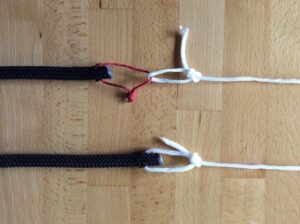
In the first method, a length of accessory cord (red here) is threaded through a hole in the rope and tied off. This system is also sometimes used to identify individual or batches of rope.
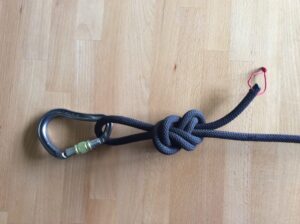
The tracer (white) is tied into this loop and then the rope (black) is pulled up into position, the tracer cord removed, and a karabiner attached ready for the activity (fig. 2 below).
In the second method, the tracer is threaded directly through a hole in the climbing rope itself which is then hauled up, the tracer cord removed, and a karabiner attached (fig. 3 below).
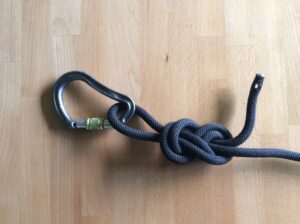
In this incident, the first method had been used. It appears that the karabiner was accidentally unclipped from the rope during a changeover and then re-attached to the accessory cord instead of into the climbing rope (fig. 4 below).
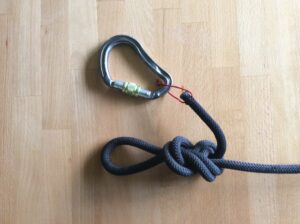
Crucially this was not noticed by the instructor, the participant, or other members of the group. When the system was loaded, the accessory cord failed and the participant fell to the ground, suffering a fractured elbow.
Key issues raised:
- Checking systems matter. Shared checking processes that actively involve participants, peers and instructors are more reliable than systems that depend on a single individual.
- Design influences error. Systems that make incorrect actions physically impossible (for example, clipping directly into the rope rather than an auxiliary loop) reduce the likelihood of error. It isn’t possible to clip into a loop which isn’t there!
- Adaptations to equipment change risk. Any modification or addition to equipment can introduce new unintended consequences and failure pathways. These should be identified, risk‑assessed and clearly explained to staff and participants.
- The safety chain is not fixed. Components not intended to be load‑bearing can still become part of the safety system if human error allows it. Just because something was never intended to become part of the safety chain doesn’t mean it won’t!

Scan to read online